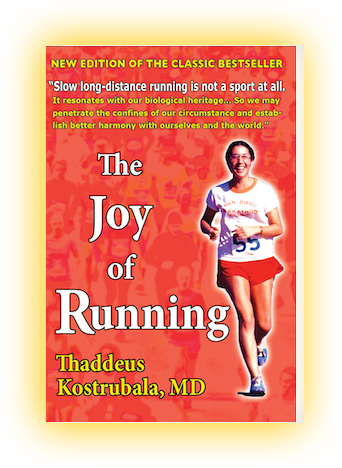
The Joy of Running


The Joy of Running Cover Page

By Thaddeus Kostrubala, M.D.

Published by J.B. Lippincott in the Summer of 1976


Dr. Kostrubala published the first use of an aerobic activity, such as running, for the treatment of mental illnesses such as depression, thus establishing Primacy for the use of this therapy.

At the time of publication of The Joy of Running, the mental health professions were dominated by Freudian theories and practice. The patient lay supine on a couch with the analyst sitting behind the patient.

This submissive position of the patient is further enhanced by the fact that the visual cues of facial expressions of the analyst are not available to the patient.

The therapeutic technique utilized and described by Dr. Kostrubala in The Joy of Running was considered revolutionary as the patient and psychiatrist were upright and on equal footing.

Dr. Kostrubala observed the effects of this form of therapy and constructed an overarching theory which he called Paleoanalysis to account for the many effects he observed and documented.


The Joy of Running was in publication for ten years. It was also published in Japan, Australia, New Zealand, Mexico and Italy.

An estimated one million copies were published. Dr. Kostrubala is considered the originator and “The Father of Running Therapy” using exercise in the treatment of various forms of mental illness.

The Beginning

I started John Boyer’s cardiac rehabilitation program on September 22, 1972, my 42nd birthday. Late in 1973 I gave a half hour talk to a group of about 75 runners, all from the San Diego area. I wrote a short paper for that talk.

It was the first time I had presented my observations about the effects of running to any group. That audience was attentive. I was quite apprehensive as I wondered if what I had observed was just simply idiosyncratic.

I ended the talk. There were no questions and I now was certain that I had made a fool of myself.

As I left the small stage the majority of that audience came down to the stage and began telling me that they had the identical or very similar experiences when running. I was taken aback. It seemed that I was at least somewhat correct in what I had experienced.

Emboldened by that response I attempted to have an expanded version of that paper for the talk printed in a professional journal. The rejections were prompt and polite.

I decided to attempt the publishing houses and sent copies of that paper to as many publishing houses I could find. They all responded with rejections except for J.B. Lippincott.  They accepted my proposal and sent a contract for the as yet unnamed book offering $3,000.

I was so excited that I did not enter into any negotiation with them. I did not have an agent. Instead I said I would prefer $2,638.50 instead of the $3,000. The number I chose represented the 26 miles 385 yards of a marathon.

I was assigned an editor, David Bradley and I began to write. I hand wrote at night, had it typed and sent on to David. We spoke frequently on the telephone. David suggested chapters and a comment he made stuck with me. “You are a long distance runner but you write like a sprinter.” He encouraged me to expand and explain. I think I treated writing as if I were writing a prescription because that is exactly how I conceived of what I was doing. I was trying to help people I had not met and did not know. They were anonymous patients.

After about 7 months the writing was done. Proofs were sent to me and now I began to think of a name when David called and said the name of the book was, The Joy of Running.

I was not at all pleased. I did not see what I was writing about as “Joy”. Besides what did “Joy” really mean? To me it sounded like The Joy of Cooking or worse, The Joy of Sex.

I objected and David told me that the decision was made by the publisher. They liked the title. I could object and they simply would not publish the book. I submitted. TJOR was in the birth canal.

In the early summer of 1976 hard cover copies of TJOR were sent to me and my life promptly changed. I was called by reporters and interviewed by various reporters.

In one of those interviews I met Dominick Bosco. He was working for Prevention Magazine. We became friends and have been in constant contact since that interview.

I was repeating myself and answering various questions. One of the most astonishing things that happened was the interview by Valerie Andrews. She wrote a book that was published called, The Psychic Power of Running. I don’t think it sold too well because the prescription I wrote required hard work.

About a year after The Joy of Running had been published, David Bradley told me the story of how the book had been named. He said the Lippincott salesman had a prolonged and liquid lunch with the Pocketbook salesman and towards the end of the meeting the Pocketbook salesman asked what the name of the running book was. The Lippincott salesman knew the book had not been named and blurted out, The Joy of Running.


I associate that Christening with one evening when the doorbell rang. It was 1979. There was a man at the door who looked to be in his late 40’s or early 50’s. He was very polite and said he came to see me because he wanted to thank me. He said he was an alcoholic and had been in AA for many years but it had not worked for him. But, after reading TJOR AA worked and he was grateful.

One lady came to interview me for several days. She was in her late 30’s and did not run. She was polite but I could sense a feeling of negative tension. Finally she said: “I can’t write this interview because I hate you. My husband read your book, started running and like you he began to get up early to run before work. He met a younger woman and left me. If he hadn’t read your book I would still be married to him.”

That wasn’t the only such incident.

In one of the running therapy groups started at San Diego State a woman called and said that if her husband didn’t quit the group she was going to divorce him.

I asked her why and she said: “His personality has changed. He used to be quiet and soft. Now he talks way too much and he isn’t the man I married.” We had tested this man with the Myers-Briggs inventory and before he began the running group he was clearly an introvert. We tested him again after his wife’s call and he came out as a marked extravert. He had changed.

He decided to stop the running group.

As the San Diego Marathon Clinic grew I began to hear similar stories. Relationships changed. People changed.

To make this point my own wife, Ann Lewis, completed 5 marathons and informed me that our marriage was over. The Joy of Running? She had changed. What Joy was there in this? Now, many years later, I am able to see that her decision was correct. But, at that time I was profoundly unnerved.

The book, TJOR, was in print for ten years. It was also printed in Japan, Australia, New Zealand, Mexico and Italy.